



This fall, Excelsior Wellness broke ground on a first-of-its-kind housing model in Spokane: a 25-unit intergenerational apartment complex, currently dubbed the Northwest Boulevard Project. The housing will connect older adults seeking affordable, permanent housing with young adults aging out of foster care.
“The statistics on homelessness among youth aging out of foster care is staggering,” said Andrew Hill, president and CEO of Excelsior Wellness. To help limit the number of young adults ending up homeless following foster care, the housing aims to provide a safe place to live as well as predictability for young adults no longer eligible for foster care services. The structured living situation envisioned is like what many young adults experience in their college years.
"How can we provide for these young adults the same way we do for college students: housing, a residential advisor, meal plans, medical access, and educational support?” continued Hill.
In this way, the concept extends beyond just housing, translating a university campus environment into a neighborhood environment for young adults who need the same things.
In this way, the concept extends beyond just housing, translating a university campus environment into a neighborhood environment for young adults who need the same things.
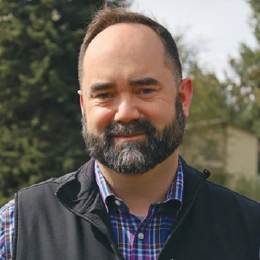 Andrew Hill
President & CEO
Excelsior Wellness
Building fabric.
Young adults need something developmentally responsive to them. That’s the idea behind a college campus community with residential advisors, counseling services, and communal areas. In the same way, young adults coming out of the foster care system need a community that meets them where they’re at. Instead of amenities seen in typical apartment complexes — rec room, pool, or gym — the goal of Excelsior Wellness is that the community serves as those, better connecting residents to the neighborhood and building community fabric.
“We realized the goal wasn’t to pack the building with amenities, but to create a campus-like environment where the real amenity is Gildred's Garage,” said Hill.
Gildred’s Garage, located just north of the apartments, has been developed as a workforce development center specializing in electrical vehicle maintenance training. In addition to offering training opportunities, apartment residents can gather and host the neighborhood in the space. And above Gildred’s will be a two-bedroom unit for an RA or campus manager.
“Think about the opportunity for a young adult to move through a campus or university environment, and how long it takes them to get their feet on the ground,” said Hill. “We wanted to replicate that same wraparound support and environment for young adults, no matter their life circumstances.”

Rendering of Northwest Boulevard Project.
Two-way mentorship.
In visits to similar housing in Venice, CA and Portland, OR, the Excelsior Wellness team saw the power and benefit of bringing together young adults and elders. And not just to the benefit of young adults.
“We're seeing there are these developmental needs as a young adult and as seniors that seem to fit and promote meeting each other's needs in some pretty intriguing ways,” said Hill. “There's this natural exchange that just works, they look out for each other.”
First and foremost, the Northwest Boulevard Project is permanent housing. It isn’t a program, nor are there any requirements that youth or elders perform counseling. Just like any other apartment complex, but with the uniqueness that its amenity is a neighborhood gathering place and that the residents make up different age demographics. It provides a much-needed step on the continuum of services by those aged out of other foster care services, and also has the amenity of skills training at Gildred’s for all residents.
“We could be sparking interest in a vocation or career path for an older adult just as easily as we do for a young adult.”
Financing with the future in mind.
When Hill stepped into his role leading Excelsior Wellness, he had a vision for the organization beyond not only providing services, but also to help solve some of the community and neighborhood problems in the area. This vision has helped spur the 10-year expansion of their Indian Trail campus to become its own village on 32 acres, complete with housing, retail, and services. The idea is to keep people supported and connected and that a person could keep their belonging to a neighborhood intact, regardless of life circumstances.
“If we could keep kids from entering foster care in a neighborhood by providing single family homes, so even if they lose their parents, they stay in their neighborhood and school, that’s the goal,” said Hill. “They could live in the village center with elders or foster parents, keeping their sense of belonging intact.”
Hill sees the Northwest Boulevard Project in line with this concept, but on a smaller scale, and most importantly, replicable. Instead of the multigenerational permanent housing situated with a garage teaching EV maintenance skills, it could be next to a neighborhood gym where personal training and fitness skills can be developed, or a car dealership where sales and customer service skills can be honed.
This innovation caught the eye of Relationship Manager Amy Talley.
“We started thinking how do we leverage our commitment to community and help move this concept forward for the good of the community, to promote and preserve the health and the wellness of this particular neighborhood,” said Talley.
One way was to bypass the often complex and cumbersome low-income housing tax credit (LIHTC), the federal government’s main program for encouraging the development of affordable housing. Washington Trust did something it historically hadn’t done, making a $1.5M equity investment in the Northwest Boulevard Project. The repayment structure allows for funds to be deployed for potential future projects following the same model.
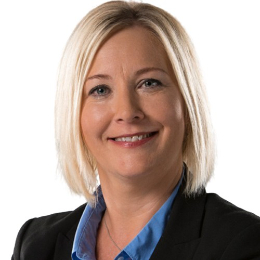 Amy Talley
SVP, Relationship Manager
Washington Trust
NLMS #796275
“We started thinking how do we leverage our commitment to community and help move this concept forward for the good of the community, to promote and preserve the health and the wellness of this particular neighborhood.”
Additionally, the Bank partnered with the Federal Home Loan Bank of Des Moines and their Member Impact Fund to make a grant donation toward the project.
“Financially, this wasn't about building another underwritten affordable housing project,” said Hill. “It's not just a lender and an applicant, but it's a true kind of community-based partnership around these responsibilities that I think have us leaning into each other thinking differently about how we can align our missions to do something more powerful together,” concluded Hill.