




Summary
Jobs growth remained positive in December but at continued low levels.
Soundbite.
Establishment survey.
The establishment survey showed a continued bifurcated or “K” shaped pattern as seven industries added jobs and seven reduced jobs. Leisure & Hospitality and Healthcare were the two industries with the strongest jobs growth. Retail Trade and Construction were the two industries with the lowest jobs growth.

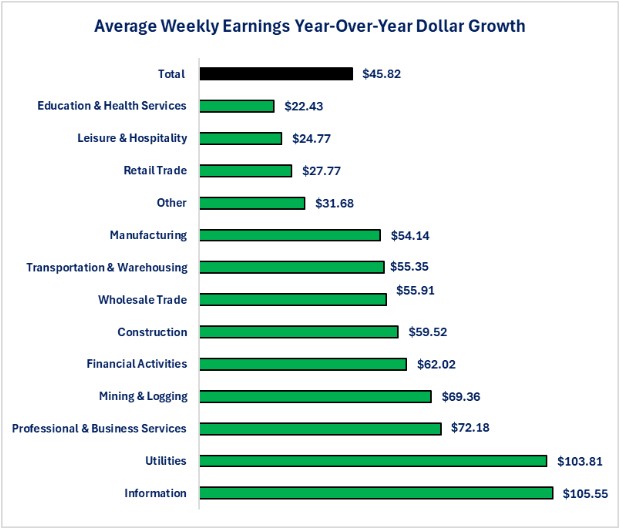
Overall, employees continue to see their average weekly earnings grow at a faster pace than inflation as average weekly earnings rose 3.8% on a year-over-year basis. The Utilities and Transportation & Warehousing sectors experienced the highest weekly wage growth while the Education & Health Services industry had the lowest. When measured in dollars rather than growth, we continue to see a large disparity in dollar growth among the industry sectors. The Information industry sector experienced a $105.55 year-over-year increase in their average weekly wage while the Education & Healthcare sector only rose by $22.43. The average hourly worker did not see an increase in their wages due to working longer hours as the average work week fell from 34.3 hours to 34.2 hours.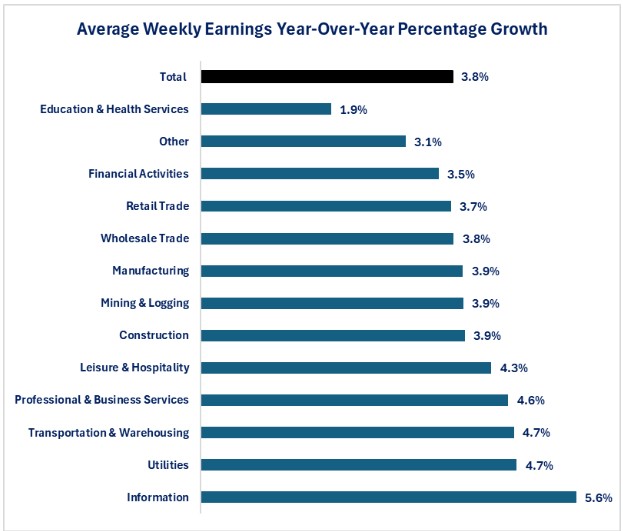
Household survey.
The Household Survey reported a 232,000 increase in the number of people employed but also reported the number of people unemployed fell by 278,000. This resulted in the unemployment rate falling from 4.5% to 4.4%. There continues to be disparity in the unemployment rate base on race.
- The Asian population has the lowest unemployment rate, and it was unchanged at 3.5%.
- The White population unemployment rate fell from 3.9% to 3.8%.
- The Hispanic or Latino population unemployment rate fell from 5.0% to 4.9%
- The Black population experienced the biggest improvement in its unemployment rate as it fell from 8.2% to 7.5%, but it still remains the highest.
The labor force contracted by 46,000 and the number of people not in the labor force grew by 229,000. As a result, the labor force participation rate fell from 62.5% to 62.4%. The number of people working part-time for economic reasons fell by 146,000. A potentially encouraging sign is the fact that the number of part-time workers fell by 740,000 while the number of full-time workers rose 890,000. Less encouraging news was the fact that the number of people working multiple jobs rose by 288,000. The number of people working multiple jobs as a percentage of total employed rose from 5.9% to 6.1%. People working multiple jobs is a potential sign of financial stress as continued high prices may be forcing them to work multiple jobs.
For those already unemployed, the news was not encouraging. The average duration of unemployment rose from 23.1 weeks to 24.4 weeks. The percentage of people who have been unemployed for 27 weeks or more rose from 24.4% to 26.0%. This supports the narrative that the media has been discussing where it is taking longer to find a new job once you become unemployed.
Conclusions.
- December's jobs report was positive, but not outstanding.
- Jobs growth remains bifurcated and concentrated.
- The percentage of people working multiple jobs as a percentage of total employed continues to rise and is a potential sign of financial stress for that part of the working population.
- The data continues to show that firms are not aggressively laying off people (i.e., the initial jobless claims number remains stable) but, if you do get laid off it is taking longer to find a new job as evidenced by the average duration of unemployment extending and the percentage of people unemployed for 27 weeks or more growing.
- December's jobs data will most likely create additional debate and potential disagreement among Federal Reserve members over whether to reduce its overnight borrowing rate or leave it unchanged.

Steve is the Economist for Washington Trust Bank and holds a Chartered Financial Analyst® designation with over 40 years of economic and financial markets experience.
Throughout the Pacific Northwest, Steve is a well-known speaker on the economic conditions and the world financial markets. He also actively participates on committees within the bank to help design strategies and policies related to bank-owned investments.