




Summary
The nation lost 92,000 jobs in February. In addition, January's results were revised down to 126,000 jobs added compared to the original estimate of 130,000. December's results were revised from a gain of 48,000 to a loss of 17,000. Ten industries lost jobs while five gained jobs. Employees continued to see solid wage gains as average weekly earnings rose 4.1%. The unemployment rate rose from 4.3% to 4.4% as the total number of employed people fell 185,000.
Establishment Survey
Job losses were widespread as ten industries lost jobs and only five industries gained jobs. The leader for jobs growth over the past year was the Health Care & Social Assistance industry. In February this industry suffered the second highest job losses with a loss of 18,600 jobs. Only Leisure & Hospitality lost more jobs as that industry lost 27,000. The industry with the highest jobs growth was the Financial Activities industry sector as it gained 10,000 jobs.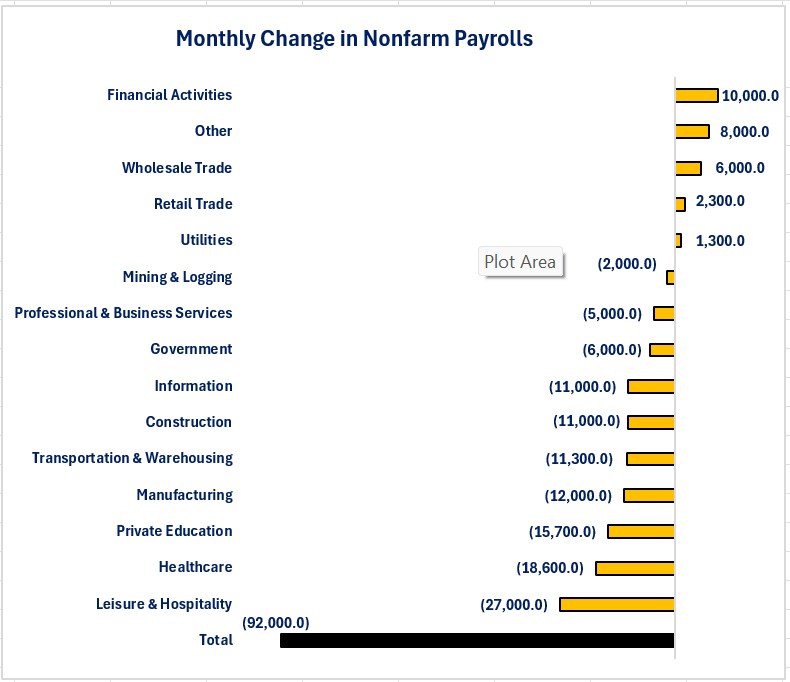
The graph below shows what percentage of total jobs each industry comprises. The job losses and gains did not cause any significant change compared to last month when rounded to one decimal point.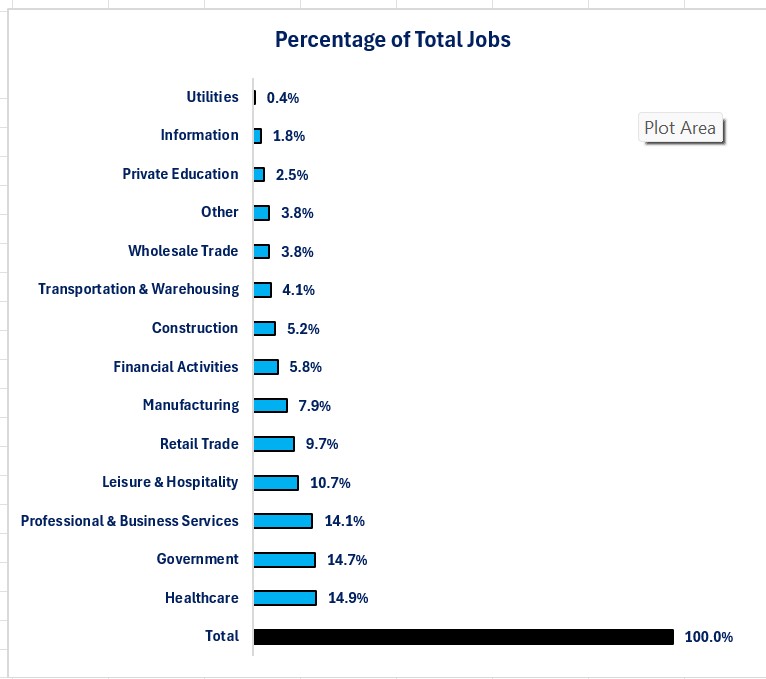
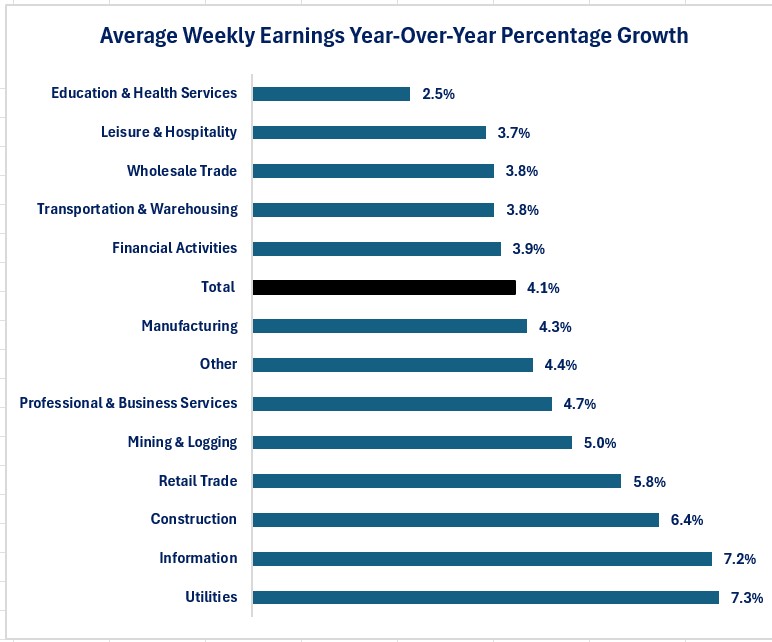
For those employees who kept their jobs, they were rewarded with a solid pay increase. Average weekly earnings rose 4.1% overall compared to last February. Education & Health Services experienced the smallest increase at 2.5% while those in the Utilities industry saw the largest increase at 7.3%.
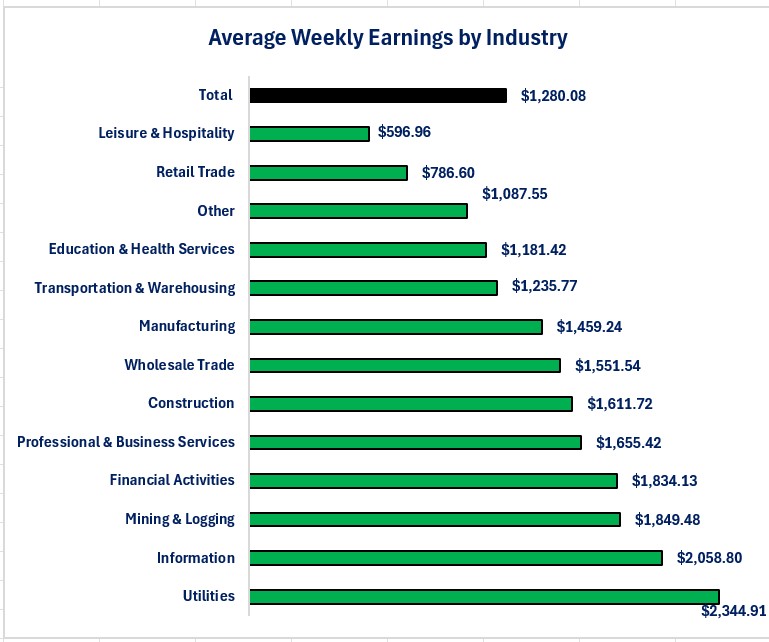
Leisure and Hospitality continues to have the lowest average weekly earnings and the Utilities industry continues to have the highest. The gap between the highest average weekly earnings and the lowest is currently $1,747.95 per week. Average hours worked per week remained unchanged at 34.3 hours.
Household survey.
The Household Survey showed a decrease of 185,000 employed people. The labor force grew by 90,000 and the number of unemployed people increased by 203,000. This caused the unemployment rate to increase from 4.3% to 4.4%. The Labor Force Participation rate fell from 62.1% to 62.0%. People with less than a high school diploma experienced the biggest increase in their unemployment rate as the rate increased from 5.3% to 5.6%.
Conclusions.
-
The loss of jobs was broad based and even impacted the industry that had been the major job creator over the last year-Health Care & Social Assistance.
-
Just as concerning is the continued downward revisions from previous months.
-
The jobs market continues to weaken, and January's growth now looks like it might have been an anomaly.
-
February's job losses and the continued pattern of downward revisions to previous months will be the argument that will be used for those Federal Reserve members who want to lower the overnight borrowing rate. The uncertainty over the impact of the current war with Iran on supply chains and prices will be the argument that those Federal Reserve members who advocate no change to the overnight rate.

Steve is the Economist for Washington Trust Bank and holds a Chartered Financial Analyst® designation with over 40 years of economic and financial markets experience.
Throughout the Pacific Northwest, Steve is a well-known speaker on the economic conditions and the world financial markets. He also actively participates on committees within the bank to help design strategies and policies related to bank-owned investments.