


If there’s one thing the Spokane AgShow never fails to deliver, it’s perspectives. Talking with producers, vendors, and ag professionals this year made one thing clear: while the challenges in agriculture continue to shift, so do the opportunities. Whether it’s land values, the sweeping One Big Beautiful Bill, or the tight margins farmers continue to face, the themes that surfaced offer a meaningful snapshot of where the industry stands — and where it’s heading.
Land values
The short answer to any question regarding what something costs is “It depends.” When it comes to agriculture land values, it depends on a lot: is the land irrigated or non-irrigated, permanent plantings or rotational crops, pasture or cropland, does the land include buildings or not, just to name a few. At the state level, the non-irrigated price per acre saw a jump from 2020 to 2022, but has largely leveled off. Irrigated land in Idaho and Oregon have been on an upward trend dating back to 2015 with 2020 bringing an acceleration.
County-by-county trends will vary, but generally in eastern Washington and north Idaho, dryland acreage values are stable with tepid increases. Farm owners and out-of-state investors continue to compete for land. Investors are seeking a return via land appreciation while owners are looking for more land to expand their operations in an industry that continues to require expansion to remain competitive.
One Big Beautiful Bill provisions
The One Big Beautiful Bill has many implications for farm owners, operators, and families. Producers should be having conversations with their professional service providers — CPA, attorney, etc. — to ensure they are taking full advantage of new provisions and protecting themselves from possible pitfalls. Some key areas to pay attention to include:
- Farm Safety Net & Commodity Program Enhancements.
The bill significantly strengthens the farm safety net by raising reference prices 10–21%, expanding ARC/PLC and crop insurance funding, and increasing payment limits and loan rates. These changes give farmers more reliable income protection during low price or volatile market conditions. - Shifts in Farm Business Structures.
Because payment rules now interact more heavily with entity type, many farmers may need to rethink their business structures to maximize payment eligibility and manage long term financial planning. This shift becomes increasingly important as payments begin flowing in a tight-income environment. - Major Tax Changes Affecting Farmers.
The bill restores 100% bonus depreciation, expands Section 179 to $2.5M, makes the 20% QBI deduction permanent, and raises the estate tax exemption —substantially improving tax planning and cash flow for producers. These provisions allow farmers to write off equipment and some buildings immediately, reduce tax burdens, and better preserve family farm assets. - Payment Limit & Entity Treatment Changes.
LLCs and S Corps can now be treated like partnerships so each active owner receives their own payment limit, increasing the overall payments multi member farms can qualify for. This change benefits operations with multiple active family members or partners without requiring restructuring.
Farm profitability concerns
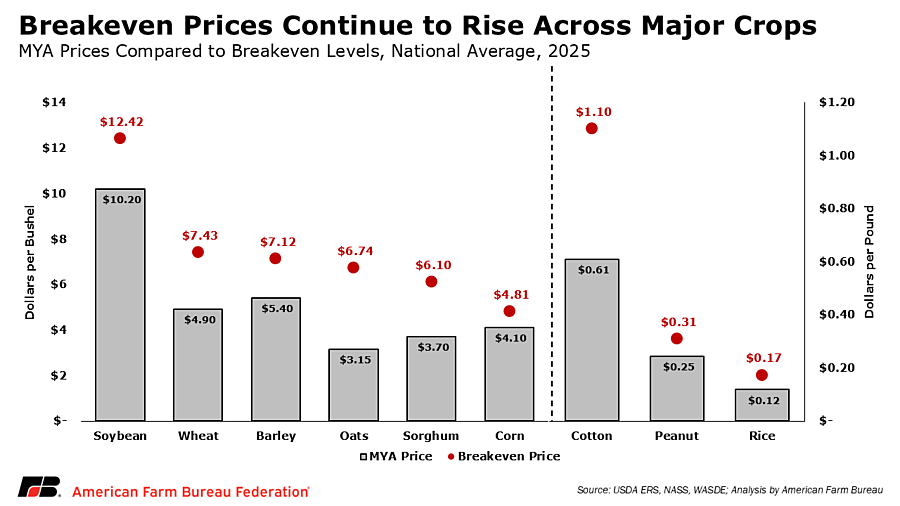
Apart from cattle, which continues to receive a healthy price, the last few years have been hard for ag producers. Wheat, one of the area’s most prolific crops, has hovered around $5 a bushel since 2024, roughly half the price received during a peak in May 2022 of $10.50. Low commodity prices combined with steadily rising productions costs is making breakeven difficult, which may be a trend that continues in 2026.
With these conditions, cash flow and access to credit are paramount. Washington Trust has local bankers in Washington, Idaho, and Oregon who know the ag industry. From needing a sounding board to purchasing equipment, they’re always available. Connect with one in your backyard.
This article touched on three of many themes that emerged from the Spokane AgShow, but they underscore the complexity of today’s ag economy — stable but competitive land markets, major policy changes, and commodity prices that continue to squeeze margins. Yet they also highlight the resilience and adaptability of producers across the Northwest. In an environment requiring cash flow, planning, and trusted guidance, partnering with professionals who understand the ag landscape can make a measurable difference. Washington Trust’s local bankers stand ready to help producers navigate uncertainty and plan for the future with confidence.