



Summary
After an initial scare that the economy was losing jobs, updates show a better story. The nation added 162,000 jobs in August and the initial reports of a 23,000 jobs loss in July now show 21,000 jobs were added. Before anyone screams “manipulation!” the reality is that it takes 3 months to get the majority of the survey results back from participating businesses. The revisions simply reflect more information. The good news is that the revisions for the past two months showed upward revisions compared to the pattern of downward revisions that have been occurring for most of the year. June's number was revised from 20,000 jobs added to 31,000 jobs added. July's number was revised from 23,000 jobs lost to 21,000 jobs added. The unemployment rate remained unchanged at 4.1%. Overall, the August Employment Situation Report confirms Federal Reserve Chairman Warsh's assessment that the overall labor market is not in trouble and inflation is what the Federal Reserve will continue to focus on. This increases the odds of the Federal Reserve raising its overnight borrowing rate at its September meeting.
Analysis
Although the nation added 162,000 jobs in August, the jobs growth continues to remain concentrated. The top two industry sectors accounted for 60% of the total jobs growth in August and the reality is that the industry that added the most jobs (Leisure & Hospitality) is the lowest paying industry. The industry that has led jobs growth for most of the year (Healthcare & Social Assistance) was the third highest job creator in August.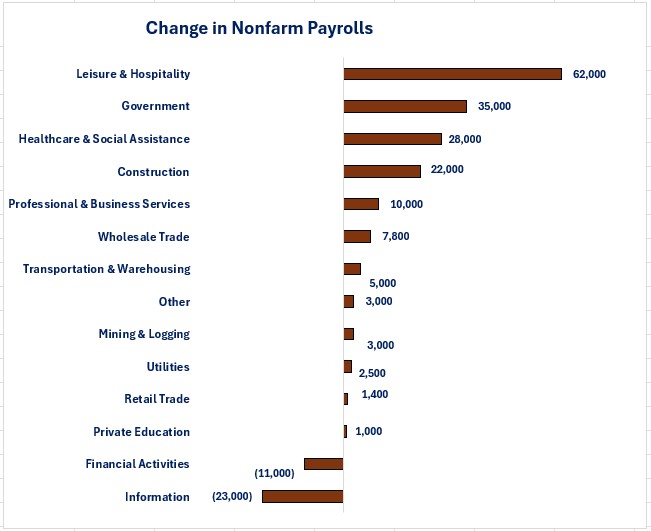
The chart below shows that, when examining growth year-to-date, the Healthcare & Social Assistance industry is the clear leader. This industry has accounted for almost 50% of total jobs growth in 2026. Four industries lost jobs in 2026. The Information and Financial Activities industries have been the leaders in job losses.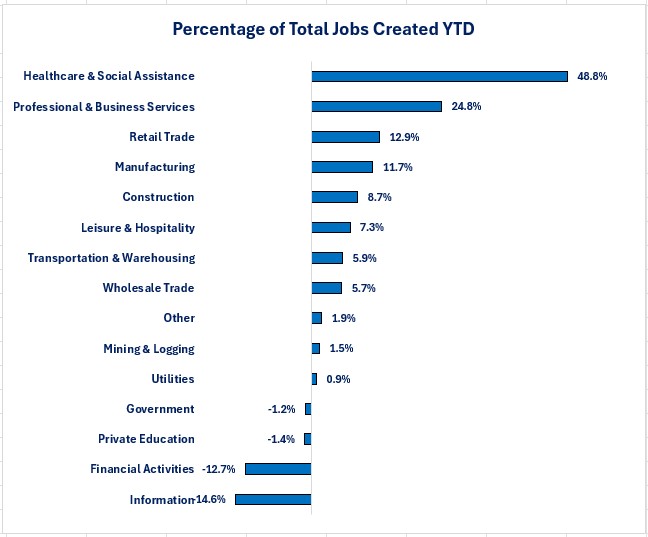
Overall, wage growth was a solid 3.6% year-over-year but there continues to be a wide gap in growth levels by industry. The Utilities industry experienced the highest growth at a 10.6% year-over-year rate while the industry that has been added the most jobs experienced the lowest wage growth at 1.6%.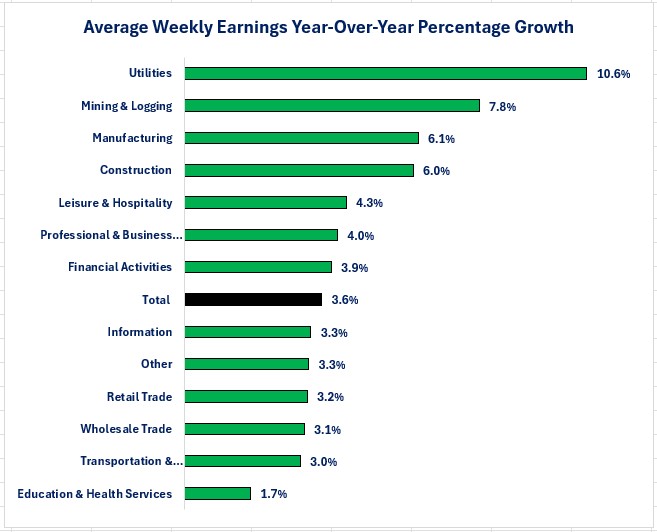
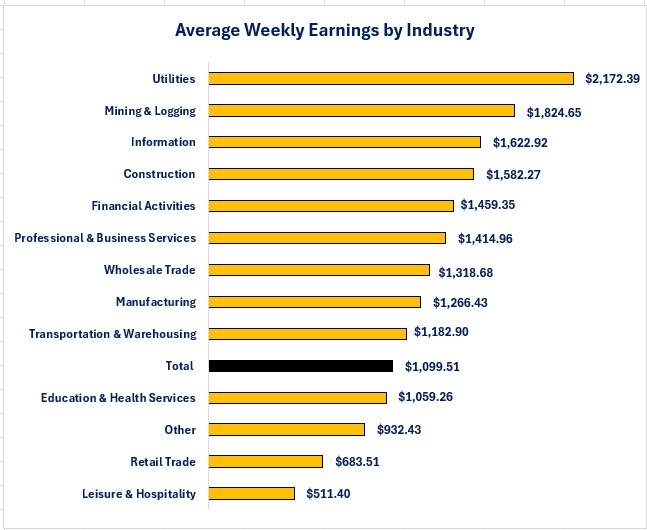
The “K” shaped economy is evident when examining wage levels. The leader in the upper leg of the K is the Utilities industry with average weekly earnings of $2,172.29. The laggard in the bottom leg of the K is the Leisure & Hospitality industry with average weekly earnings of $511.40. The reality is that the three highest paying industries (Utilities, Mining& Logging, and Information) only account for 2.5% of total jobs while the three lowest paying industries (Leisure & Hospitality, Retail Trade and Other Services) account for 24.2% of total jobs. Companies increased the average work week slightly in August as the average hours worked rose from 34.3 hours to 34.4.
The volatility between what the Establishment Survey shows for jobs growth and the Household Survey for employment growth continues. The Household Survey reported a 684,000 increase in the labor force. This was broken down by a 569,000 increase in the number of employed people and 115,000 increase in the number of unemployed people. The chart below provides a breakdown of the Household Survey results by race/ethnicity. The surge in the labor force resulted in the labor force participation rate increasing from 61.4% to 61.6%. Although this was solid improvement, the perspective is that the labor force participation rate was 62.3% a year ago. The labor force has clearly been impacted by deportation of people who were working and in the labor force. 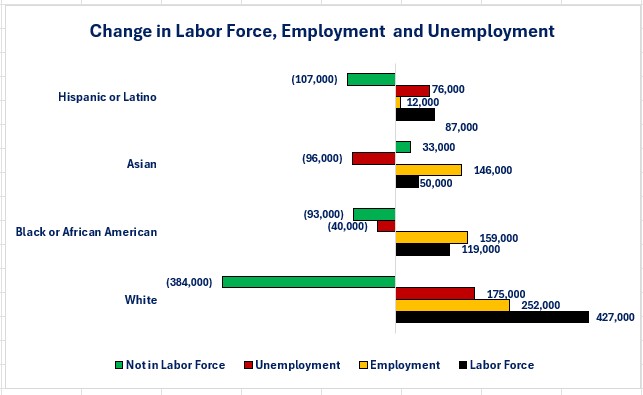
For those already unemployed, the data deteriorated. The average duration of unemployment rose from 24.9 weeks to 26.3 weeks. The percentage of people unemployed for 27 weeks or more rose from 25.5% to 27.0%
Conclusions
-
The Employment Situation Report was positive overall as the pace of jobs growth increased and the previous two months were revised up.
-
Jobs growth remains concentrated and the growth is happening in lower paying industries.
-
The new income generated from the new jobs clearly helps support consumer spending and economic growth. The fact that growth is happening in the lower paying industries may not help the new employee in their efforts to pay their bills and deal with the rising cost of household goods and services.
-
Overall, the August Employment Situation Report confirms Federal Reserve Chairman Warsh's assessment that the overall labor market is not in trouble and inflation is what the Federal Reserve will continue to focus on. This increases the odds of the Federal Reserve raising its overnight borrowing rate at its September meeting.
Data Source

Steve is the Economist for Washington Trust Bank and holds a Chartered Financial Analyst® designation with over 40 years of economic and financial markets experience.
Throughout the Pacific Northwest, Steve is a well-known speaker on the economic conditions and the world financial markets. He also actively participates on committees within the bank to help design strategies and policies related to bank-owned investments.